Older kitchen wiring
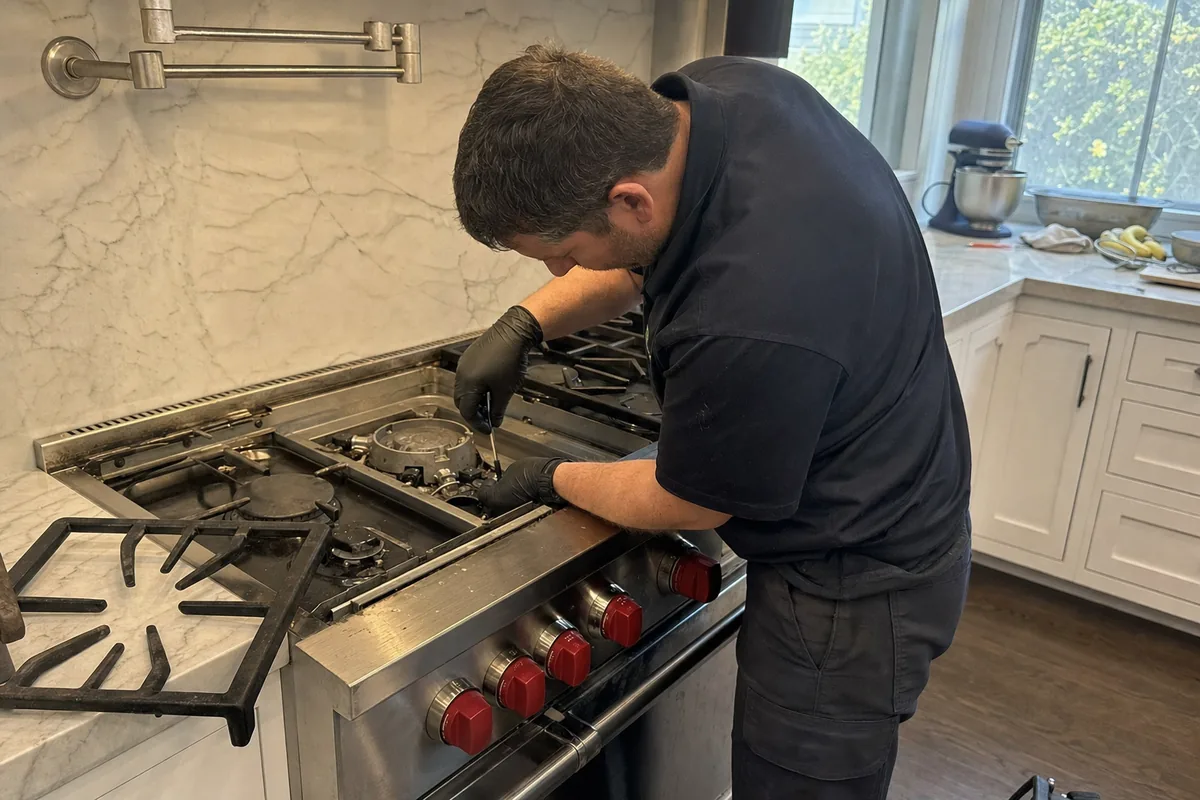
Thermador Professional Range and Gas Stove Repair
One appliance doing two jobs. The rangetop half and the oven half fail in completely different ways, and a range visit has to cover both properly.
Symptoms we hear
Behaviour rather than a code: we do not publish fault codes we cannot verify, and a symptom narrows a diagnosis further than a number.
- The oven takes far longer to preheat than it used to
- Baking is browning heavily on one side and staying pale on the other
- The oven will not light at all while the surface burners work
- The door will not close flush and heat escapes at the top corners
- The self-clean cycle ran and the oven has been dead ever since
- The convection fan rattles, hums or stops mid-cycle
- A set temperature of 350 measures 30 degrees or more off with a probe
- The oven light stays on or the door lock will not release
What actually fails
- Oven ignition components that weaken gradually, giving long preheats before they give a total failure
- The oven temperature sensor drifting out of tolerance, which shows as calibration error rather than as a dead oven
- Thermal cutouts and fuses that open during or immediately after a self-clean cycle
- Door hinges and springs sagging under the weight of a professional door, breaking the seal at the top
- Convection fan motors and their bearings, which announce themselves before they fail
- Grease migration from the burner box into the oven controls on ranges used hard
Two appliances in one cabinet
A professional range is a rangetop bolted to an oven, and the two halves have almost nothing in common mechanically. The top fails through ignition, gas flow and control valves. The oven fails through heat, and heat is patient. It works on hinges, on door seals, on sensor accuracy and on the plastics behind the control panel, and it does its work slowly enough that most owners adapt to the decline before they call anyone.
That adaptation is the thing we listen for. When somebody says they always add ten minutes and turn the tray halfway through, they are describing a measurable fault, not a preference.
Calibration is a measurement, not an opinion
We bring a probe. A range that reads 350 on the display and measures 318 in the centre of the cavity has a specific problem with a specific cause, and it is usually the temperature sensor rather than the control board. Sensors drift with age and with repeated self-clean cycles, and the drift is almost always in one direction. We take readings at more than one setpoint, because a sensor that is close at 350 and far out at 450 tells a different story than one that is evenly wrong.
Uneven browning left to right is a different fault entirely. That is airflow, door seal or a convection fan that is turning slower than it should, and no amount of recalibration fixes it.
The self-clean problem
Pyrolytic cleaning takes the cavity far above any temperature it sees in normal cooking, and it puts every component near the oven under stress for hours. The classic aftermath is an oven that completes the cycle, cools down, and is then completely dead: no display, no response, nothing. That pattern usually points at a thermal cutout or fuse that has done its job and opened.
Replacing it is straightforward. Replacing it without asking why it opened is not. If the cooling fan is weak, if the vent path is blocked, or if the oven was run on self-clean with racks and spillage still inside, the same part will open again. We check the cause before we quote the cure.
Old kitchens, big ranges
A 48-inch professional range going into a house built in the 1920s in Riverside, Avondale or Ortega is not a drop-in. Those kitchens were laid out for equipment a third of the size, the cabinet openings are narrow and out of square, and the electrical supply for the oven controls, the ignition and the convection fan is frequently sharing a circuit with half the room. We have seen ranges that fault intermittently for years because the supply sags whenever something else on the same circuit starts.
When we find that, we tell you it is an electrical problem and not an appliance problem. We would rather lose the parts sale than sell you a control board that was never at fault.
Grease, hoods and the burner box
Ranges that get used properly accumulate grease in places nobody sees, and the migration path runs from the burner box toward the control area. Under a hood that is undersized or ducted badly, that migration accelerates. Where we find control faults on a range whose ventilation is not keeping up, we say so, because that is the difference between a repair and a repeat visit.
Terms
The diagnostic is $80, flat, and it is credited toward the repair when you approve the work. You get a written estimate before we order or fit anything. Parts are genuine OEM through the same BSH distribution channel that serves Thermador, Bosch and Gaggenau, with 90 days on labour and 365 days on parts. We are an independent repair company and hold no manufacturer authorization of any kind.
Local factor
Older kitchen wiring
Pre-war kitchens in Riverside, Avondale and Old Ortega were never wired for modern built-in loads, and the appliance takes the blame for the circuit.
Which is why the first questions on a call are where the appliance is installed and how long it has been there, not which model it is.
How the visit works
Diagnostic
$80 flat diagnostic, credited toward the repair when you approve the work.
Estimate
A written estimate comes before any part is ordered or fitted. How pricing works
Warranty
90 days labour, 365 days parts, genuine OEM components. Warranty terms
Parts
Genuine OEM parts, ordered through the same BSH distribution channel that serves Thermador, Bosch and Gaggenau.
Price bands
Parts and labour together, for work completed.
What does professional range repair cost?
Between $80 and $1,100, depending which component is at fault. Before the appliance is opened a band is the honest answer; a single number is a guess in a quote's clothing.
| What turns out to be at fault | Typical range |
|---|---|
| Diagnostic visit, credited against the repair | $80 |
| Oven thermostat or temperature sensor | $170–$550 |
| Control board or touch panel | $440–$1,100 |
| Convection fan or motor | $260–$710 |
| Igniter, spark module or surface element | $190–$500 |
Asked before a professional range visit
Is the $80 diagnostic charged again if a part has to be ordered?
No. $80 is charged once; the fitting visit is the same job, and the charge is credited against the repair once you approve it. A written estimate comes before any part is ordered or fitted.
The oven takes far longer to preheat than it used to — what is usually behind that?
The short list on this class is oven ignition components that weaken gradually; oven temperature sensor drifting out of tolerance; thermal cutouts and fuses that open during or immediately after a self-clean cycle. We reproduce the complaint and measure rather than take it on description: those are separable on the day, and replacing the wrong one is how an owner pays twice.
Is a professional range repair worth it, or is it time to replace?
Past the diagnosis, oven thermostat or temperature sensor usually lands at $170–$550, and control board or touch panel at $440–$1,100. Replacing instead is $4,200–$14,500 for the equipment alone, before delivery, fitting, or the joinery a built-in is cut into. On this class the repair wins the arithmetic far more often than it loses it.
What moves the figure up or down after the diagnosis?
Which component it turns out to be, before anything else: the table above is a band per part class, not per symptom. After that it is whether the part is current or a superseded revision, whether the appliance has to come out of its opening to reach it, and whether a second fault shows while it is open.
What happens after the repair is finished?
90 days labour, 365 days parts, genuine OEM components. Genuine OEM parts, ordered through the same BSH distribution channel that serves Thermador, Bosch and Gaggenau. Anything you notice afterwards on the work we did is a telephone call, not a fresh diagnostic.
Customer reviews
4.3 out of 5, across 101 customer reviews
After a professional ranges visit
One visit each, in the words we were given, unflattering ones included.
The range works properly now. Getting to that point took three calls from me and one appointment that came and went without anybody ringing, which is the reason this is not a higher score.
Arden Y.2025-04-17
Two of the burners would light but not hold a low flame. He stripped and cleaned the burner caps, reset the simmer adjustment at the valves, and they now hold steady without going out.
Georgia H.2026-05-14
The griddle plate had stopped getting up to temperature at the back. He traced a failed element and a loose spade connector that had been arcing, replaced both and rechecked the surface with a probe.
Hector I.2026-04-30
Where this comes up
Areas naming this appliance class lead, then the rest — nearest by road within each.
3 mi by road · 8 min
Fruit Cove
6 mi by road · 12 min
Mandarin
12 mi by road · 24 min
Orange Park
17 mi by road · 28 min
Riverside and Avondale
12 mi by road · 20 min
Nocatee
13 mi by road · 22 min
Deerwood
Read first
Articles covering this appliance class, pulled from their own frontmatter.
5 min read
Dead after self-clean
A wall oven that completes a clean cycle and then goes completely dead is a recognisable fault with a recognisable cause. What opened, and why it opened.
6 min read
Old kitchen circuits
Riverside, Avondale and Ortega kitchens were wired long before dedicated 20A circuits. How shared supply produces appliance faults that test fine afterwards.
6 min read
Before you call
Some faults are not faults. A short list of checks worth doing first, and the details that make a diagnostic visit faster and cheaper when one is needed.
5 min read
Oven temperature calibration
Calibrating oven temp means measuring the true heat, then entering an offset: -35°F to +35°F on display ovens, or a knob routine on Professional ranges.
5 min read
Thermador oven lifespan
A Thermador oven has no fixed lifespan: the cavity is built to be repaired, so its life is set by the igniters, elements, fan and controls. What fails first.
Related appliances
Gas rangetops
Star burners, ExtraLow simmer and a griddle or grill module in one drop-in top. Most faults are ignition, gas flow or a control that has stopped cycling correctly.
Wall ovens
Built into cabinetry, carrying a heavy door and a lot of heat. Wall ovens fail at the door, at the sensor and at whatever the last self-clean cycle pushed too far.
Ventilation
Hoods, inline blowers and roof-mounted units. The motor is often nowhere near the kitchen, and on the coast it is sitting in salt air all year.
Induction cooktops
Full-surface induction is an electronics platform under a sheet of glass. When a zone dies it is almost never an element, and diagnosis has to start at the inverter boards.
One of nine classes, and nothing outside the kitchen
Meridian Appliance Works opens built-in kitchen appliances, and that is the whole list: Thermador wall ovens, steam ovens and speed ovens, professional ranges, gas rangetops, induction cooktops, refrigerator, freezer and wine columns, dishwashers, and the ventilation hung over the cooking surface.
We do not service heating, air conditioning or ductwork. No furnaces, no heat pumps, no air handlers, no mini-splits, no duct cleaning and no duct replacement — not as a sideline, and not handed to a partner firm. A house that will not warm up or will not cool down is a licensed HVAC contractor's job, and we say so on the telephone instead of booking a visit we could not finish.
Independent, and saying so plainly
Meridian Appliance Works is an independent service company. We name Thermador only to say which appliances we work on: built-in equipment from Thermador and the rest of the BSH Home Appliances line, diagnosed and repaired by our own technicians using genuine OEM parts.
Next step
Book a diagnostic
Tell us the appliance and what it is doing. We will give you a written estimate before anything is ordered.
Mon–Fri 8am–6pm · Sat 9am–4pm
Request a visit- $80 flat diagnostic, credited toward the repair when you approve the work.
- 90 days labour, 365 days parts, genuine OEM components.