Storm-season boards
Thermador Oven Repair: Wall Ovens, Single and Double
Built into cabinetry, carrying a heavy door and a lot of heat. Wall ovens fail at the door, at the sensor and at whatever the last self-clean cycle pushed too far.
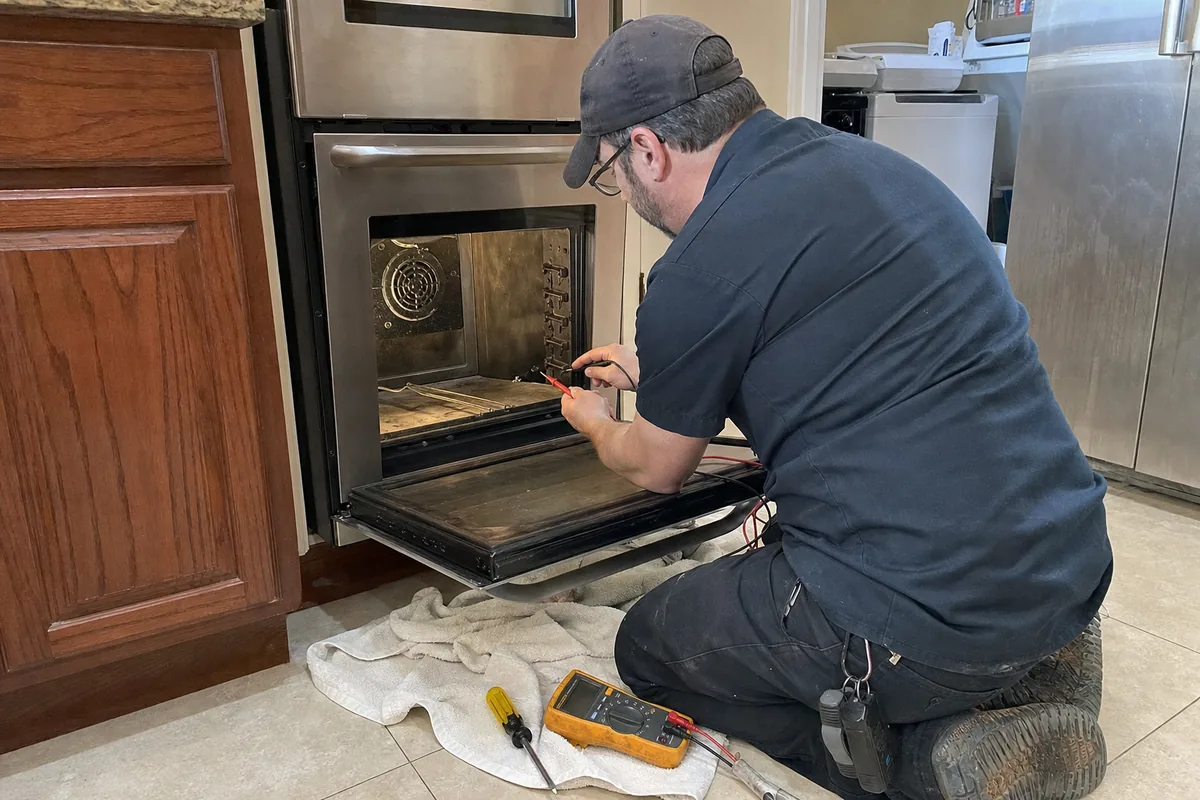
Symptoms we hear
Behaviour rather than a code: we do not publish fault codes we cannot verify, and a symptom narrows a diagnosis further than a number.
- The oven is dead with no display after a self-clean cycle
- The oven is working but not heating up, with the fan running and the display lit
- Preheat takes twice as long as it did a year ago
- The door sits proud at the top and the seal no longer touches
- Roasting browns the back of the tray and leaves the front pale
- The cooling fan runs for a very long time after the oven is switched off
- The door latch cycles but never releases after cleaning
- The upper oven works normally and the lower oven does nothing
- The touch panel responds only when pressed hard or in one corner
What actually fails
- Door hinges and hinge springs, which sag under a heavy professional door and open a gap at the top of the seal
- Bake and broil elements failing at a visible break or silently losing resistance
- The oven temperature sensor drifting after repeated pyrolytic cycles
- Thermal cutouts and cooling fans, which are the usual pair behind a dead oven after self-clean
- Door glass packs that delaminate or fog between the panes
- Touch control panels and the ribbon connections behind them
Built in means built around
A wall oven is not a freestanding appliance up high. It is a box fitted into joinery often built to hold it and nothing else, and that governs both the diagnosis and the cost. Almost every serious repair begins by taking the oven’s weight out of the cabinet far enough to reach the back, and under a stone counter in custom cabinetry that is the part of the job needing planning rather than strength.
We check three things before we start pulling: whether the oven can come forward without removing trim that will not go back, whether the supply behind it has enough slack, and whether the cabinet has been modified since installation. In older Southside and Mandarin kitchens where a single oven has been swapped for a double, the answer to the third question is frequently yes.
The door does more work than anything else
The most under-appreciated component on a wall oven is the door. It carries multiple glass panes, swings on hinges under spring tension, and seals a cavity that runs to 900 degrees on a clean cycle. When the hinges begin to sag, the door stops sitting square, the gasket loses contact at the top corners, and heat pours out into the cabinet.
The symptoms owners report are almost never described as a door problem. They report long preheats, uneven baking, a hot cabinet face, or a cooling fan that runs half an hour after cooking. All four are consistent with a seal that no longer seals. We check door alignment with a straightedge and check the gasket by hand along its whole run before we touch anything electrical.
Dead after a clean cycle
Pyrolytic self-clean is the hardest thing a wall oven ever does. It runs for hours at a temperature nothing else in the kitchen reaches, and it stresses every part in the cabinet at the same time. The most common way that ends badly is a completely dead oven once the cycle finishes and the cabinet cools.
That points to a thermal cutout, and the cutout is doing exactly what it exists to do. The question worth answering is what made the temperature climb far enough to open it. Nine times out of ten it is a weak cooling fan, a blocked vent path, or a clean cycle run with racks and heavy spillage still inside. We diagnose the cause and put it in writing, because replacing the fuse alone buys you one more clean cycle.
Boards, storms and supply
Around 68 thunderstorm days a year is enough to matter for any appliance with a relay board and a touch interface. Wall ovens sit on a heavy dedicated circuit that usually runs a long way through the house, and a surge event tends to take out one stage rather than the whole appliance. An oven that stopped responding during a storm week deserves a proper diagnosis rather than an assumption that the control board is gone: we have found more than a few where the fault was upstream of the appliance entirely.
Double ovens and shared parts
On a double wall oven, the upper and lower cavities usually share a control system and a cooling path but have their own elements and sensors. When only one cavity is affected, that narrows the fault dramatically. When both are affected, it narrows it in the other direction. We ask which cavities are behaving and we test both, even when you have only reported one.
Terms
The visit is a flat $80 diagnostic, credited toward the repair when you approve the work, with a written estimate before anything is ordered or fitted. Genuine OEM parts through the BSH distribution channel that also supplies Bosch and Gaggenau, 90 days on labour, 365 days on parts. Appointments Monday to Friday 8am to 6pm and Saturday 9am to 4pm.
Local factor
Storm-season boards
Around 68 thunderstorm days a year put repeated transient stress on control boards and power supplies.
Which is why the first questions on a call are where the appliance is installed and how long it has been there, not which model it is.
How the visit works
Diagnostic
$80 flat diagnostic, credited toward the repair when you approve the work.
Estimate
A written estimate comes before any part is ordered or fitted. How pricing works
Warranty
90 days labour, 365 days parts, genuine OEM components. Warranty terms
Parts
Genuine OEM parts, ordered through the same BSH distribution channel that serves Thermador, Bosch and Gaggenau.
Price bands
Parts and labour together, for work completed.
What does wall oven repair cost?
Between $80 and $1,100, depending which component is at fault. Before the appliance is opened a band is the honest answer; a single number is a guess in a quote's clothing.
| What turns out to be at fault | Typical range |
|---|---|
| Diagnostic visit, credited against the repair | $80 |
| Oven thermostat or temperature sensor | $170–$550 |
| Door hinge, glass or seal | $180–$690 |
| Control board or touch panel | $440–$1,100 |
| Bake or broil element | $200–$540 |
Asked before a wall oven visit
Is the $80 diagnostic charged again if a part has to be ordered?
No. $80 is charged once; the fitting visit is the same job, and the charge is credited against the repair once you approve it. A written estimate comes before any part is ordered or fitted.
The oven is dead with no display after a self-clean cycle — what is usually behind that?
The short list on this class is door hinges and hinge springs; bake and broil elements failing at a visible break or silently losing resistance; oven temperature sensor drifting after repeated pyrolytic cycles. We reproduce the complaint and measure rather than take it on description: those are separable on the day, and replacing the wrong one is how an owner pays twice.
Is a wall oven repair worth it, or is it time to replace?
Past the diagnosis, oven thermostat or temperature sensor usually lands at $170–$550, and door hinge, glass or seal at $180–$690. Replacing instead is $4,200–$14,500 for the equipment alone, before delivery, fitting, or the joinery a built-in is cut into. On this class the repair wins the arithmetic far more often than it loses it.
What moves the figure up or down after the diagnosis?
Which component it turns out to be, before anything else: the table above is a band per part class, not per symptom. After that it is whether the part is current or a superseded revision, whether the appliance has to come out of its opening to reach it, and whether a second fault shows while it is open.
What happens after the repair is finished?
90 days labour, 365 days parts, genuine OEM components. Genuine OEM parts, ordered through the same BSH distribution channel that serves Thermador, Bosch and Gaggenau. Anything you notice afterwards on the work we did is a telephone call, not a fresh diagnostic.
Customer reviews
4.3 out of 5, across 101 customer reviews
After a wall ovens visit
One visit each, in the words we were given, unflattering ones included.
The convection fan had begun to screech at temperature. He replaced the fan motor and its bearing housing. It is quiet again, although a second trip was needed because the part was not on the van.
Franklin G.2026-05-28
The door on the upper cavity had started to sag and heat was escaping past the seal. He rebuilt the hinges and fitted a new gasket. It shuts properly now, though it took longer than either of us expected.
Bram C.2026-07-23
It bakes evenly again, which was the complaint. What annoyed me was the protective film left on the new trim and a smear of grease down the cabinet door that I ended up cleaning myself.
Wendell U.2025-02-24
Where this comes up
Areas naming this appliance class lead, then the rest — nearest by road within each.
6 mi by road · 12 min
Mandarin
12 mi by road · 24 min
Orange Park
13 mi by road · 22 min
Deerwood
17 mi by road · 28 min
Riverside and Avondale
18 mi by road · 30 min
Oakleaf
28 mi by road · 40 min
St. Augustine
Read first
Articles covering this appliance class, pulled from their own frontmatter.
5 min read
Dead after self-clean
A wall oven that completes a clean cycle and then goes completely dead is a recognisable fault with a recognisable cause. What opened, and why it opened.
6 min read
Storms and control boards
This region averages about 68 thunderstorm days a year. Why appliance boards fail in clusters afterwards, and how to tell a dead board from a supply fault.
6 min read
Before you call
Some faults are not faults. A short list of checks worth doing first, and the details that make a diagnostic visit faster and cheaper when one is needed.
5 min read
Oven temperature calibration
Calibrating oven temp means measuring the true heat, then entering an offset: -35°F to +35°F on display ovens, or a knob routine on Professional ranges.
5 min read
Thermador oven lifespan
A Thermador oven has no fixed lifespan: the cavity is built to be repaired, so its life is set by the igniters, elements, fan and controls. What fails first.
Related appliances
Steam ovens
A small water system inside an oven: fill, heat, level sensing, drain and a sealed door. Weak steam is one of those five, and they are separable in an hour.
Speed ovens
Microwave energy and convection heat in one built-in cavity, which means two heating systems, two failure sets and one high-voltage section nobody should open casually.
Professional ranges
One appliance doing two jobs. The rangetop half and the oven half fail in completely different ways, and a range visit has to cover both properly.
Induction cooktops
Full-surface induction is an electronics platform under a sheet of glass. When a zone dies it is almost never an element, and diagnosis has to start at the inverter boards.
One of nine classes, and nothing outside the kitchen
Meridian Appliance Works opens built-in kitchen appliances, and that is the whole list: Thermador wall ovens, steam ovens and speed ovens, professional ranges, gas rangetops, induction cooktops, refrigerator, freezer and wine columns, dishwashers, and the ventilation hung over the cooking surface.
We do not service heating, air conditioning or ductwork. No furnaces, no heat pumps, no air handlers, no mini-splits, no duct cleaning and no duct replacement — not as a sideline, and not handed to a partner firm. A house that will not warm up or will not cool down is a licensed HVAC contractor's job, and we say so on the telephone instead of booking a visit we could not finish.
Independent, and saying so plainly
Meridian Appliance Works is an independent service company. We name Thermador only to say which appliances we work on: built-in equipment from Thermador and the rest of the BSH Home Appliances line, diagnosed and repaired by our own technicians using genuine OEM parts.
Next step
Book a diagnostic
Tell us the appliance and what it is doing. We will give you a written estimate before anything is ordered.
Mon–Fri 8am–6pm · Sat 9am–4pm
Request a visit- $80 flat diagnostic, credited toward the repair when you approve the work.
- 90 days labour, 365 days parts, genuine OEM components.