Storm-season boards
Thermador Freedom Induction Cooktop Repair
Full-surface induction is an electronics platform under a sheet of glass. When a zone dies it is almost never an element, and diagnosis has to start at the inverter boards.
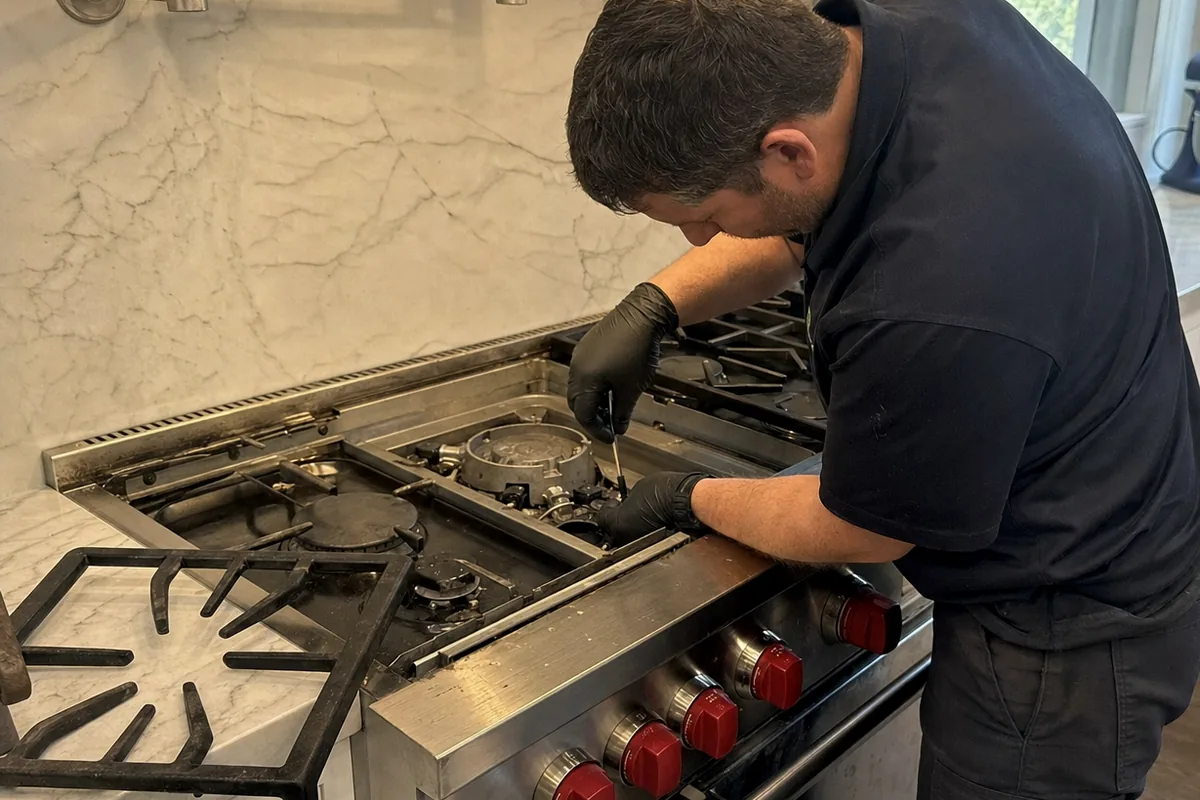
Symptoms we hear
Behaviour rather than a code: we do not publish fault codes we cannot verify, and a symptom narrows a diagnosis further than a number.
- One area of the glass no longer heats while the rest of the surface works
- The display lights up but no zone will start under any pan
- The cooktop runs for ten or fifteen minutes and then shuts the zone down
- A pan that used to be recognised is now reported as no pan detected
- Fan noise from under the cabinet that keeps running long after cooking
- Touch controls respond in one region of the panel and ignore another
- Power drops on its own from a high setting to a low one
- A hairline crack or chip in the glass with the surface still operating
What actually fails
- Inverter and coil boards, which fail per zone group rather than across the whole surface
- The electronics cooling fan, which draws grease-laden air from the cabinet and stalls on the bearing
- The touch control and display interface, including its ribbon connection to the main board
- Under-glass thermistors that shut a zone down early when they drift or lose contact
- Installations with blocked underside clearance, which cook the inverters and cause repeat failures
- Supply-side faults on one leg of the 240V feed, which present as half the cooktop being dead
A cooktop with no burners
The Freedom Induction Cooktop is not a hob with elements under it. It is a dense array of induction coils and inverter electronics laid edge to edge beneath one piece of glass, with pan detection deciding in real time which coils to energise and how to group them. That architecture is why the language customers use on the phone rarely maps onto the fault. There is no burner to replace, no element to swap, and no simple continuity test that settles the question. When the left-hand third of a 48-inch surface stops responding, the honest first question is which inverter board covers that third and whether it is the board, its supply leg, or the interface telling it to run.
We diagnose these units cold, then under load, then thermally. A zone that heats for twelve minutes and quits is behaving differently from a zone that never starts, and the two failures live in different parts of the machine.
What we check first, and why
Pan detection is the most common false alarm. Induction couples to ferrous metal, so a pan that has warped, that has a sandwich base with a thin magnetic layer, or that has simply been replaced with a nicer non-magnetic one, will read as absent. We carry a magnet and a known-good test pan, and if the cooktop recognises ours it has told us something useful for free.
After that the order is unglamorous. We confirm both legs of the 240V supply at the appliance, not at the panel, because a single open leg produces exactly the symptom of half a cooktop working. We read the cooling fan, because these surfaces reject a surprising amount of heat downward and the fan is the only thing standing between the inverters and their own waste heat. Then we get into the boards.
Why installation quality decides the repair bill
Full-surface induction needs air. The manufacturer specifies clearance beneath the unit and around the cabinet cutout for a reason, and in this market we regularly open cabinets where a drawer box, a granite substrate, a run of ducting or a well-meaning sheet of insulation has closed off that path. The cooktop will work. It will also cook its own inverters, and it will do it again eight months after a board replacement.
When we find that, we say so in the written estimate before any part is ordered. Replacing a board into an installation that killed the last one is not a repair, it is a subscription. Sometimes the fix is a cabinet modification that takes an hour and costs nothing in parts.
Storm-season electronics
Northeast Florida averages around 68 thunderstorm days a year. Induction cooktops are the most electronics-dense appliance in most of the kitchens we work in, and they sit on a dedicated high-current circuit that runs a long way back to the panel. We see interface boards that survive a nearby strike while the inverter stage does not, and we see units that come back to life once the supply is corrected. A cooktop that went dark during a storm is worth diagnosing rather than replacing.
Glass, and when to stop
A chipped or cracked surface is a stop. The glass is structural and it is the only barrier between the coils and everything spilled on top of them. We will not power up a cracked surface for a customer, and we will tell you plainly when the glass cost puts the repair close enough to replacement that the decision belongs to you rather than to us.
What a visit looks like
A flat $80 diagnostic covers the visit and the findings, and it is credited toward the repair when you approve the work. You get a written estimate before a part is ordered or fitted. Parts come through the same BSH distribution channel that serves Thermador, Bosch and Gaggenau, which is one of the practical advantages of these appliances sharing a parent. Labour carries 90 days, parts carry 365.
We are an independent shop. What we have is time on these specific machines and a habit of proving the fault before quoting the part.
Local factor
Storm-season boards
Around 68 thunderstorm days a year put repeated transient stress on control boards and power supplies.
Which is why the first questions on a call are where the appliance is installed and how long it has been there, not which model it is.
How the visit works
Diagnostic
$80 flat diagnostic, credited toward the repair when you approve the work.
Estimate
A written estimate comes before any part is ordered or fitted. How pricing works
Warranty
90 days labour, 365 days parts, genuine OEM components. Warranty terms
Parts
Genuine OEM parts, ordered through the same BSH distribution channel that serves Thermador, Bosch and Gaggenau.
Price bands
Parts and labour together, for work completed.
What does induction cooktop repair cost?
Between $80 and $1,100, depending which component is at fault. Before the appliance is opened a band is the honest answer; a single number is a guess in a quote's clothing.
| What turns out to be at fault | Typical range |
|---|---|
| Diagnostic visit, credited against the repair | $80 |
| Control board or touch panel | $440–$1,100 |
| Door hinge, glass or seal | $180–$690 |
| Convection fan or motor | $260–$710 |
Asked before a induction cooktop visit
Is the $80 diagnostic charged again if a part has to be ordered?
No. $80 is charged once; the fitting visit is the same job, and the charge is credited against the repair once you approve it. A written estimate comes before any part is ordered or fitted.
One area of the glass no longer heats while the rest of the surface works — what is usually behind that?
The short list on this class is inverter and coil boards; electronics cooling fan; touch control and display interface. We reproduce the complaint and measure rather than take it on description: those are separable on the day, and replacing the wrong one is how an owner pays twice.
Is a induction cooktop repair worth it, or is it time to replace?
Past the diagnosis, control board or touch panel usually lands at $440–$1,100, and door hinge, glass or seal at $180–$690. Replacing instead is $4,200–$14,500 for the equipment alone, before delivery, fitting, or the joinery a built-in is cut into. On this class the repair wins the arithmetic far more often than it loses it.
What moves the figure up or down after the diagnosis?
Which component it turns out to be, before anything else: the table above is a band per part class, not per symptom. After that it is whether the part is current or a superseded revision, whether the appliance has to come out of its opening to reach it, and whether a second fault shows while it is open.
What happens after the repair is finished?
90 days labour, 365 days parts, genuine OEM components. Genuine OEM parts, ordered through the same BSH distribution channel that serves Thermador, Bosch and Gaggenau. Anything you notice afterwards on the work we did is a telephone call, not a fresh diagnostic.
Customer reviews
4.3 out of 5, across 101 customer reviews
After a induction cooktops visit
One visit each, in the words we were given, unflattering ones included.
Our induction top kept throwing an error and shutting down mid cook. He found the cooling fan choked with dust and a temperature sensor on the coil reading high. Cleaned, sensor replaced, no errors.
Selma S.2025-12-11
The surface kept shutting itself down under heavy use. He found the underside air path blocked by a drawer liner fitted below it, cleared that and rechecked temperatures through a long boil.
Hesper F.2025-07-17
Repair done and the surface is fine. The silicone bead around the glass was left uneven at one corner, and there is a scratch on the stone beside it that was certainly not there before.
Kester I.2025-08-25
Where this comes up
Areas naming this appliance class lead, then the rest — nearest by road within each.
12 mi by road · 20 min
Nocatee
12 mi by road · 24 min
Orange Park
17 mi by road · 28 min
Riverside and Avondale
18 mi by road · 26 min
World Golf Village
18 mi by road · 30 min
Oakleaf
3 mi by road · 8 min
Fruit Cove
Read first
Articles covering this appliance class, pulled from their own frontmatter.
6 min read
Before you call
Some faults are not faults. A short list of checks worth doing first, and the details that make a diagnostic visit faster and cheaper when one is needed.
6 min read
Storms and control boards
This region averages about 68 thunderstorm days a year. Why appliance boards fail in clusters afterwards, and how to tell a dead board from a supply fault.
6 min read
Old kitchen circuits
Riverside, Avondale and Ortega kitchens were wired long before dedicated 20A circuits. How shared supply produces appliance faults that test fine afterwards.
Related appliances
Ventilation
Hoods, inline blowers and roof-mounted units. The motor is often nowhere near the kitchen, and on the coast it is sitting in salt air all year.
Professional ranges
One appliance doing two jobs. The rangetop half and the oven half fail in completely different ways, and a range visit has to cover both properly.
Gas rangetops
Star burners, ExtraLow simmer and a griddle or grill module in one drop-in top. Most faults are ignition, gas flow or a control that has stopped cycling correctly.
Wall ovens
Built into cabinetry, carrying a heavy door and a lot of heat. Wall ovens fail at the door, at the sensor and at whatever the last self-clean cycle pushed too far.
One of nine classes, and nothing outside the kitchen
Meridian Appliance Works opens built-in kitchen appliances, and that is the whole list: Thermador wall ovens, steam ovens and speed ovens, professional ranges, gas rangetops, induction cooktops, refrigerator, freezer and wine columns, dishwashers, and the ventilation hung over the cooking surface.
We do not service heating, air conditioning or ductwork. No furnaces, no heat pumps, no air handlers, no mini-splits, no duct cleaning and no duct replacement — not as a sideline, and not handed to a partner firm. A house that will not warm up or will not cool down is a licensed HVAC contractor's job, and we say so on the telephone instead of booking a visit we could not finish.
Independent, and saying so plainly
Meridian Appliance Works is an independent service company. We name Thermador only to say which appliances we work on: built-in equipment from Thermador and the rest of the BSH Home Appliances line, diagnosed and repaired by our own technicians using genuine OEM parts.
Next step
Book a diagnostic
Tell us the appliance and what it is doing. We will give you a written estimate before anything is ordered.
Mon–Fri 8am–6pm · Sat 9am–4pm
Request a visit- $80 flat diagnostic, credited toward the repair when you approve the work.
- 90 days labour, 365 days parts, genuine OEM components.