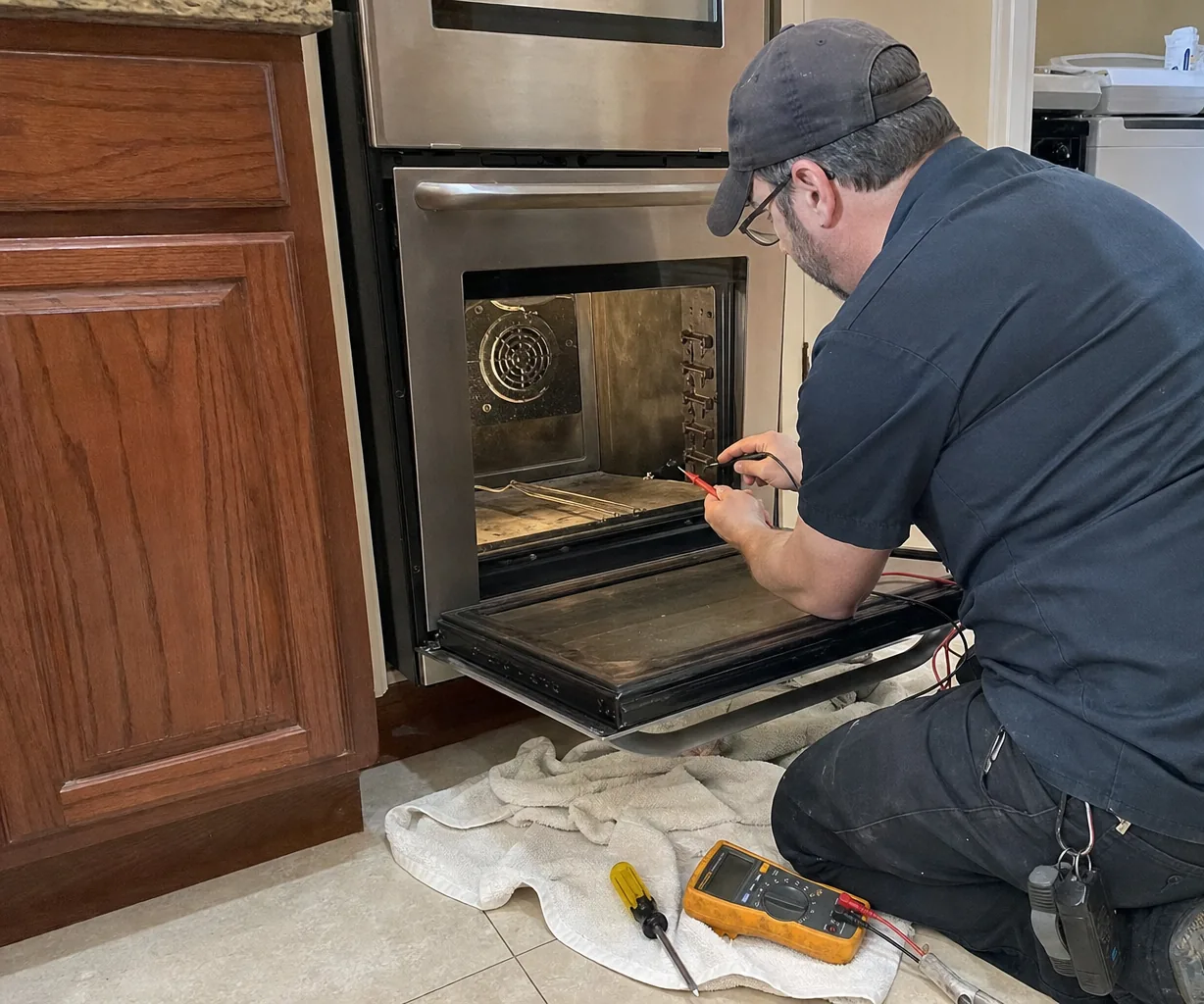
How long a Thermador oven lasts has no single answer in years, because the oven is built to be repaired rather than replaced: the steel cavity, frame and door are rarely what gives out. Its working life is set by the parts bolted around the box. Igniters, bake and broil elements, the convection fan, door seals and the electronic controls each wear on their own clock, and nearly all of them can be replaced. One failed part on an otherwise sound oven is a repair; three failures in a row on an old one is a different conversation.
What wears out, roughly in the order it happens
Not every oven follows this sequence, but the pattern is familiar:
- Gas igniters on range ovens and rangetops. Thermador describes them as fragile ceramic parts. A tired oven igniter shows up as a long wait before the flame catches, or a faint smell of gas while you wait.
- Bake and broil elements on electric ovens. They blister, sag or crack, often right after a self-clean, and the oven then heats slowly or only from one direction.
- The convection fan motor. Worn bearings announce themselves with a grind or a squeal that gets louder over months.
- Door gasket and hinges. A flattened seal lets heat leak out at the top corners; a heavy door that no longer closes square is usually a hinge.
- Temperature sensor and control electronics. Drifting temperatures, error codes and a touch panel that ignores you tend to arrive later and cost the most.
Signs that age, not a single fault, is the problem
One dead element on an otherwise healthy oven is just a part. Age is the likely cause when failures start stacking up: a new element this spring, a fan noise in summer, and now the display is acting strangely.
Error codes are a useful clue. When an “E” followed by a number appears and the oven beeps, Thermador’s guidance is to press TIMERS or any key to silence it, reset the oven if needed, and call for support if the same code keeps coming back. A code that returns week after week on an older oven usually points to a sensor or a control board. If the door stays locked after the oven has cooled, switch it off at the breaker, wait five minutes and switch it back on so the controls can reset.
Temperature drift is not always wear. On range ovens without a display, the owner can recalibrate: cut power at the breaker for at least 20 seconds, open the door, turn the mode knob to BROIL, set the temperature knob (225 = -50°F through 475 = +50°F), close the door and turn the knob back to OFF.
Finding the age of your oven
Thermador builds ovens in Masterpiece and Professional styles. On Masterpiece wall ovens and steam ovens, the rating plate sits on the left side of the door trim, visible with the door open. It carries the model number (E-Nr.) and the production number (FD), which tells a technician roughly when the oven was built. Our page on model and serial numbers shows where to look on other appliances.
Repair or replace: putting numbers on it
These are typical ranges in our area; the firm figure comes after an $80 diagnostic:
A bake or broil element typically runs $200–$540, an igniter or spark module $190–$500, and a thermostat or temperature sensor $170–$550. A convection fan or motor is usually $260–$710, door hinges, glass or a seal $180–$690, and a control board or touch panel $440–$1,100. A comparable replacement wall oven typically lands in the $4,200–$9,500 range, appliance only, before any cabinet work. That last point matters: a new oven may not fit the old cutout, so even one expensive repair on a sound oven often beats replacing it. See our wall oven repair page for what a visit covers.
Warranty in the early years
Thermador lists a 2-year limited warranty covering the whole appliance, parts and labor. Using an independent repair shop does not void that warranty, though Thermador does not take responsibility for damage caused by work outside its own network. We work independently and fit genuine OEM parts; the warranty page explains both coverages.
Habits that add years
Run self-clean sparingly. Its heat is hard on elements, controls and the door lock, and it is the cycle behind many sudden failures we describe in the oven that died after self-clean. Never line the floor of a gas oven with foil; it blocks combustion air and can produce carbon monoxide. Near the beaches, salt air works on stainless trim, so wipe with the grain and skip chlorine cleaners. Northeast Florida also sees plenty of summer lightning, so surge protection at the panel is cheap insurance for oven electronics.