Storm-season boards
Thermador Speed Oven and Microwave Repair
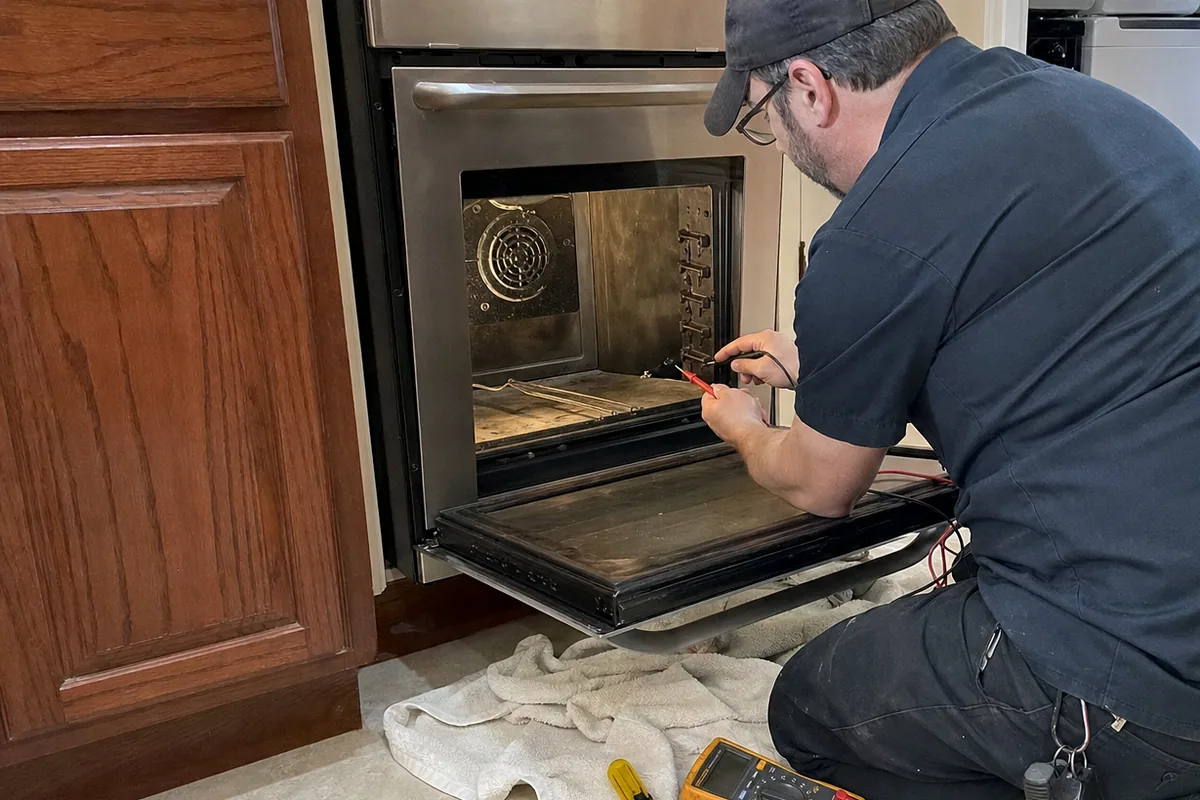
Microwave energy and convection heat in one built-in cavity, which means two heating systems, two failure sets and one high-voltage section nobody should open casually.
Symptoms we hear
Behaviour rather than a code: we do not publish fault codes we cannot verify, and a symptom narrows a diagnosis further than a number.
- The oven runs, the light comes on and the fan turns, but nothing gets hot
- A loud hum or buzz appears only when microwave power is called for
- The convection side works normally and the microwave side does not
- The door has to be lifted or pushed to make the oven accept a start
- The cavity heats unevenly with cold centres in reheated food
- The unit shuts off partway through a cycle and will not restart until it cools
- The touch panel is unresponsive in one area of the keypad
- A burning or electrical smell during microwave operation
What actually fails
- Door interlock switches, which are the most common reason a speed oven runs without heating
- The magnetron and its high-voltage supply, including the diode and capacitor
- Cooling fans and blocked cabinet vents, which cause thermal cutouts partway through a cycle
- Convection elements and fan motors on the conventional side of the cavity
- Touch control panels and the ribbon connections behind them
- Waveguide covers that char and arc after grease or food splash builds up
Two ovens sharing one cavity
A speed oven combines microwave energy with convection heat so that a single built-in unit can reheat in ninety seconds and roast properly an hour later. Mechanically it is two appliances that happen to share a door, a cavity and a control panel, and that is genuinely useful when diagnosing a fault, because the first question splits the machine cleanly in half.
If convection works and microwave does not, the fault is in the high-voltage section, the interlocks or the control that switches them. If microwave works and convection does not, we are looking at an element, a fan motor or a thermal limit. If neither works, we are looking at supply, the main board or the interface. Owners often supply that answer themselves without realising it.
The interlocks come first, every time
The most common speed oven complaint we take is that the unit lights up, the turntable or the fan runs, the timer counts down, and the food comes out cold. That is a classic no-heat pattern and its usual cause is the door interlock system rather than the magnetron.
Every microwave-capable oven has multiple switches that must agree the door is closed. They are cheap, they are mechanical, and they take the impact of every door slam over ten years. When one drifts out of adjustment or fails, the control logic prevents microwave output while allowing everything else to run. It looks catastrophic and it usually is not. If your door needs a nudge or a lift before the oven accepts a start, tell us on the phone, because that detail is diagnostic.
The part of this appliance that is genuinely dangerous
The high-voltage section of a microwave-capable oven holds enough stored energy in its capacitor to injure or kill after the unit is unplugged. There is no safe way for a homeowner to test that section, and there is no meaningful troubleshoot to attempt with the case off. If your speed oven is humming loudly, smells of burning, or has visible arcing inside the cavity, switch it off at the breaker and leave it alone until someone competent has it open.
Arcing in the cavity usually traces to a damaged waveguide cover. It is a small part and an inexpensive one, but running the oven with it charred will damage things that are neither.
Built in, so access is half the job
Speed ovens are installed into a cabinet stack, often above or below a wall oven, and frequently with a stone or tile surround that was fitted afterward. Getting one out is a controlled operation, not a pull. We check the trim, the fixings and the supply slack before we start, and where the surround makes removal genuinely risky we tell you before we begin rather than after something has chipped.
Ventilation matters here too. These units reject heat into the cabinet, and a stack that has been closed up or insulated will cause thermal shutdowns partway through longer cycles. That fault looks like an intermittent electronics problem and is not one.
Terms
Flat $80 diagnostic, credited toward the repair when you approve the work. Written estimate before any part is ordered or fitted. Genuine OEM parts through the BSH distribution channel shared with Bosch and Gaggenau, 90 days on labour, 365 days on parts. Appointments Monday to Friday 8am to 6pm and Saturday 9am to 4pm.
Local factor
Storm-season boards
Around 68 thunderstorm days a year put repeated transient stress on control boards and power supplies.
Which is why the first questions on a call are where the appliance is installed and how long it has been there, not which model it is.
How the visit works
Diagnostic
$80 flat diagnostic, credited toward the repair when you approve the work.
Estimate
A written estimate comes before any part is ordered or fitted. How pricing works
Warranty
90 days labour, 365 days parts, genuine OEM components. Warranty terms
Parts
Genuine OEM parts, ordered through the same BSH distribution channel that serves Thermador, Bosch and Gaggenau.
Price bands
Parts and labour together, for work completed.
What does speed oven repair cost?
Between $80 and $1,100, depending which component is at fault. Before the appliance is opened a band is the honest answer; a single number is a guess in a quote's clothing.
| What turns out to be at fault | Typical range |
|---|---|
| Diagnostic visit, credited against the repair | $80 |
| Control board or touch panel | $440–$1,100 |
| Convection fan or motor | $260–$710 |
| Door hinge, glass or seal | $180–$690 |
| Oven thermostat or temperature sensor | $170–$550 |
Asked before a speed oven visit
Is the $80 diagnostic charged again if a part has to be ordered?
No. $80 is charged once; the fitting visit is the same job, and the charge is credited against the repair once you approve it. A written estimate comes before any part is ordered or fitted.
The oven runs, the light comes on and the fan turns, but nothing gets hot — what is usually behind that?
The short list on this class is door interlock switches; magnetron and its high-voltage supply; cooling fans and blocked cabinet vents. We reproduce the complaint and measure rather than take it on description: those are separable on the day, and replacing the wrong one is how an owner pays twice.
Is a speed oven repair worth it, or is it time to replace?
Past the diagnosis, control board or touch panel usually lands at $440–$1,100, and convection fan or motor at $260–$710. Replacing instead is $4,200–$14,500 for the equipment alone, before delivery, fitting, or the joinery a built-in is cut into. On this class the repair wins the arithmetic far more often than it loses it.
What moves the figure up or down after the diagnosis?
Which component it turns out to be, before anything else: the table above is a band per part class, not per symptom. After that it is whether the part is current or a superseded revision, whether the appliance has to come out of its opening to reach it, and whether a second fault shows while it is open.
What happens after the repair is finished?
90 days labour, 365 days parts, genuine OEM components. Genuine OEM parts, ordered through the same BSH distribution channel that serves Thermador, Bosch and Gaggenau. Anything you notice afterwards on the work we did is a telephone call, not a fresh diagnostic.
Customer reviews
4.3 out of 5, across 101 customer reviews
After a speed ovens visit
One visit each, in the words we were given, unflattering ones included.
He found a cooling fan seized and the vent path in the cabinet above packed with dust. Cleaned and replaced, and the cutouts have stopped. I am told that cabinet vent needs watching, which seems fair.
Vaughn T.2026-01-15
The work itself was sound. Communication was not. I was left to chase the parts order and only learned the lead time when I rang about something else entirely.
Willa U.2026-01-28
Our combination unit would start a convection bake and then stop with the fan still turning. He found a temperature limiter opening early behind the right side trim, replaced it and checked the cabinet vent above it.
Wilhelmina U.2025-05-20
Where this comes up
Areas naming this appliance class lead, then the rest — nearest by road within each.
3 mi by road · 8 min
Fruit Cove
6 mi by road · 12 min
Mandarin
12 mi by road · 20 min
Nocatee
12 mi by road · 24 min
Orange Park
13 mi by road · 22 min
Deerwood
17 mi by road · 28 min
Riverside and Avondale
Read first
Articles covering this appliance class, pulled from their own frontmatter.
6 min read
Before you call
Some faults are not faults. A short list of checks worth doing first, and the details that make a diagnostic visit faster and cheaper when one is needed.
6 min read
Storms and control boards
This region averages about 68 thunderstorm days a year. Why appliance boards fail in clusters afterwards, and how to tell a dead board from a supply fault.
5 min read
Dead after self-clean
A wall oven that completes a clean cycle and then goes completely dead is a recognisable fault with a recognisable cause. What opened, and why it opened.
5 min read
Thermador oven lifespan
A Thermador oven has no fixed lifespan: the cavity is built to be repaired, so its life is set by the igniters, elements, fan and controls. What fails first.
6 min read
Steam oven makes no steam
Weak steam has four separable causes: heat, fill, level sensing and the door seal. How a technician tells them apart before replacing a steam generator.
Related appliances
Wall ovens
Built into cabinetry, carrying a heavy door and a lot of heat. Wall ovens fail at the door, at the sensor and at whatever the last self-clean cycle pushed too far.
Steam ovens
A small water system inside an oven: fill, heat, level sensing, drain and a sealed door. Weak steam is one of those five, and they are separable in an hour.
Ventilation
Hoods, inline blowers and roof-mounted units. The motor is often nowhere near the kitchen, and on the coast it is sitting in salt air all year.
Induction cooktops
Full-surface induction is an electronics platform under a sheet of glass. When a zone dies it is almost never an element, and diagnosis has to start at the inverter boards.
One of nine classes, and nothing outside the kitchen
Meridian Appliance Works opens built-in kitchen appliances, and that is the whole list: Thermador wall ovens, steam ovens and speed ovens, professional ranges, gas rangetops, induction cooktops, refrigerator, freezer and wine columns, dishwashers, and the ventilation hung over the cooking surface.
We do not service heating, air conditioning or ductwork. No furnaces, no heat pumps, no air handlers, no mini-splits, no duct cleaning and no duct replacement — not as a sideline, and not handed to a partner firm. A house that will not warm up or will not cool down is a licensed HVAC contractor's job, and we say so on the telephone instead of booking a visit we could not finish.
Independent, and saying so plainly
Meridian Appliance Works is an independent service company. We name Thermador only to say which appliances we work on: built-in equipment from Thermador and the rest of the BSH Home Appliances line, diagnosed and repaired by our own technicians using genuine OEM parts.
Next step
Book a diagnostic
Tell us the appliance and what it is doing. We will give you a written estimate before anything is ordered.
Mon–Fri 8am–6pm · Sat 9am–4pm
Request a visit- $80 flat diagnostic, credited toward the repair when you approve the work.
- 90 days labour, 365 days parts, genuine OEM components.